High performance steel wire rope is specifically designed for critical lifting applications where conventional ropes may not provide the required fatigue resistance, crushing resistance, structural stability, or operational lifespan required in modern mining and industrial environments.
AC Crane Maintenance supplies and assists with high performance steel wire rope solutions for mining, industrial, and heavy lifting applications throughout South Africa and Africa.
Built for deep shaft mining, continuous hoisting cycles, abrasive environments, heavy loads and severe duty conditions found throughout Africa.
Mining operations throughout Africa operate in some of the worldβs harshest lifting environments. Deep shaft mining, continuous hoisting cycles, heavy loads, abrasive environments, and demanding duty cycles require wire rope designed specifically for severe service conditions.
High performance compacted steel wire ropes are commonly used in demanding mining environments including:
These ropes are engineered to deliver stronger, safer and longer-lasting performance in high-duty applications.
AC Crane Maintenance supplies and assists with high performance steel wire rope solutions throughout Africa for severe mining, hoisting, crane and heavy industrial applications.
We support operations throughout Southern, Central, East and West Africa, assisting clients operating in demanding industrial and mining environments.
High performance steel wire ropes are used across a wide range of critical lifting and hoisting operations.
Unlike standard general-purpose steel wire rope, high performance rope is engineered for demanding hoisting environments where strength, stability, fatigue resistance and service life are critical.
High performance ropes are built for harsh lifting conditions where standard rope may wear faster or lose stability under repeated loading.
The correct high performance rope construction can improve operational reliability, reduce downtime and extend rope service life.
High performance compacted steel wire rope and 8-strand rope constructions are widely used in mining, crane, shaft hoisting and industrial lifting applications throughout Africa due to their superior balance between flexibility, fatigue resistance, structural stability and operational performance.
Compacted steel wire rope is manufactured by compressing the outer strands during production. This process creates a smoother, denser rope structure with improved drum contact, reduced internal movement between strands and improved metallic fill factor compared to conventional rope constructions.
8-strand rope constructions are commonly used in mining and industrial lifting systems due to their balance between flexibility, fatigue resistance and structural stability in severe service conditions.
High performance steel wire rope is selected where mine shaft hoisting systems, personnel cage systems, skip hoists and multilayer drum applications place extreme operational demands on rope strength, fatigue resistance, crushing resistance and safe lifting performance.
Mine shaft hoisting systems place extreme demands on steel wire rope due to:
Correct rope selection for mining applications should always be verified against the operating conditions, hoist design and full safety requirements of the lifting system.
Multilayer drum applications place severe pressure on steel wire rope due to rope-on-rope contact and crushing forces between layers.
High performance compacted ropes are specifically designed to improve multilayer spooling behaviour and reduce crushing forces during operation.
Understanding rope tensile grades, operational characteristics and application suitability is critical when selecting steel wire rope for mining, crane, hoisting and industrial lifting systems.
| Rope Grade | Approx Tensile Strength | Characteristics | Typical Applications |
|---|---|---|---|
| 1570 | 1570 N/mmΒ² | Lower tensile wire rope grade with improved flexibility and reduced stiffness compared to higher grades. | General lifting, light-duty cranes, winches, marine and utility applications. |
| 1770 | 1770 N/mmΒ² | Standard high-strength steel wire rope grade commonly used in industrial lifting applications. | General crane hoisting, industrial lifting, overhead cranes, hoists and winches. |
| 1870 | 1870 N/mmΒ² | Higher tensile rope grade providing increased breaking force and improved lifting performance. | Industrial cranes, heavy-duty lifting systems, marine and offshore applications. |
| 1960 | 1960 N/mmΒ² | High tensile rope grade offering improved breaking force, fatigue resistance and operational performance. | Heavy-duty cranes, mining hoists, multilayer drum systems and high-cycle lifting. |
| 2160 | 2160 N/mmΒ² | Ultra high-strength rope grade designed for demanding mining, shaft hoisting and critical lifting environments. | Deep shaft hoisting, personnel lifting systems, mine cages and extreme-duty industrial applications. |
| IPS (Improved Plow Steel) | Approx. 1770 MPa Equivalent | Traditional wire rope grade commonly used before modern metric rope grade classifications. | General industrial lifting, cranes, winches and older lifting equipment. |
| EIPS (Extra Improved Plow Steel) | Approx. 1960 MPa Equivalent | Higher strength traditional plow steel rope grade with improved breaking force. | Crane ropes, mining hoists, heavy-duty industrial lifting systems. |
| EEIPS (Extra Extra Improved Plow Steel) | Approx. 2160 MPa Equivalent | Very high-strength traditional plow steel rope grade used for demanding lifting environments. | Mining hoists, shaft hoisting, offshore cranes and extreme-duty lifting systems. |
Rope grades shown are typical industry reference grades used for steel wire rope manufacturing. Final rope selection must always be confirmed against the OEM specification, rope construction, safety factor requirements, duty cycle, operating environment and applicable standards.
The table below provides typical reference data for high performance compacted steel wire rope including rope mass, approximate minimum breaking forces and common industrial applications for mining, hoisting and heavy-duty lifting systems.
| Diameter | Mass kg/m | 1770 Grade kN | 1960 Grade kN | 2160 Grade kN | Application |
|---|---|---|---|---|---|
| 20mm | 1.799 | 325.9 | 360.5 | 378.7 | Heavy-duty hoists |
| 24mm | 2.591 | 468.3 | 518.1 | 545.4 | Industrial crane systems |
| 28mm | 3.527 | 638.8 | 706.6 | 742.3 | Mine hoisting |
| 32mm | 4.606 | 834.4 | 922.9 | 969.5 | Shaft hoisting |
| 36mm | 5.830 | 1056.0 | 1168.0 | 1227.0 | Personnel lifting |
| 40mm | 7.198 | 1304.0 | 1442.0 | 1515.0 | Heavy mining hoists |
| 48mm | 10.364 | 1877.0 | 2077.0 | 2181.0 | Deep shaft hoisting |
| 56mm | 14.107 | 2555.0 | 2826.0 | 2968.0 | Large shaft hoisting |
| 60mm | 16.194 | 2933.0 | 3245.0 | 3406.0 | Extreme-duty hoisting |
Convert steel wire rope breaking force values from kilonewtons (kN) into approximate kilograms-force and metric tons for mining, crane, hoisting and industrial lifting applications.
Enter the rope breaking force in kilonewtons (kN) to convert it into approximate kilograms-force and metric tons.
1 kN β 101.97 kgf
Tons = kg Γ· 1000
Steel wire rope breaking force is one of the most important engineering values used when selecting rope for mining, crane, shaft hoisting and industrial lifting systems.
Steel wire rope forms part of a safety-critical lifting system and must always be suitable, certified and correctly selected for the intended application.
Under South African Driven Machinery Regulations, ropes used in lifting systems must comply with applicable safety factor and lifting requirements.
AC Crane Maintenance assists clients throughout Africa with high performance steel wire rope supply, replacement, application review and technical rope guidance.
Steel wire rope is engineered in different constructions, strand configurations, lay directions and core types to suit specific mining, crane, shaft hoisting, marine and industrial lifting applications.
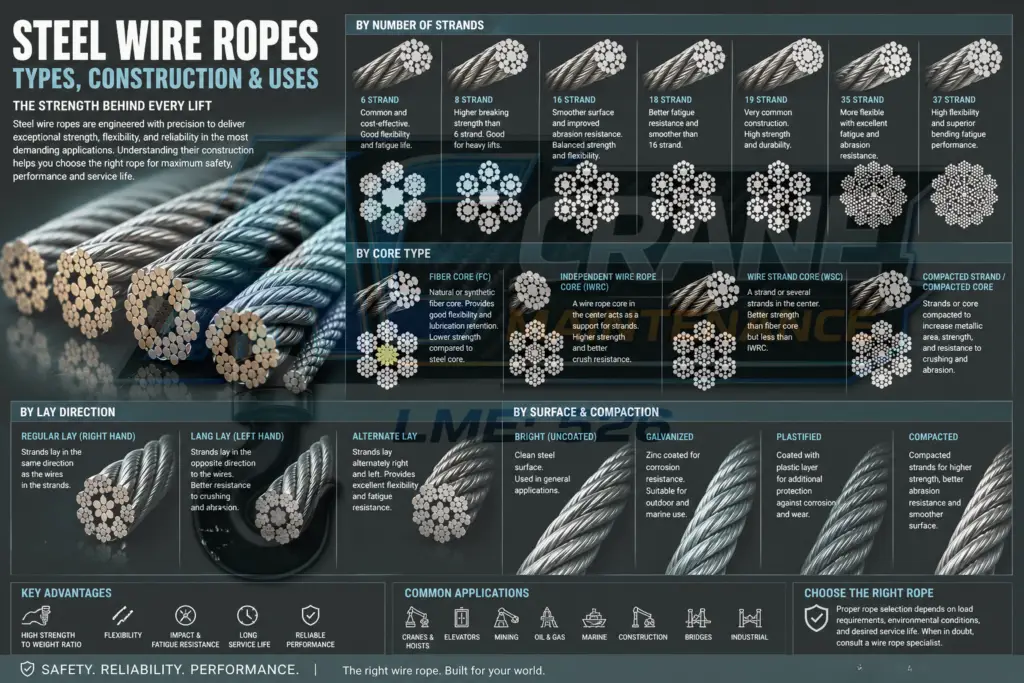
6x19 rope consists of 6 outer strands with approximately 19 wires per strand and is commonly available with fibre core (FC) or independent wire rope core (IWRC).
6x36 rope contains approximately 36 wires per strand, providing increased flexibility and improved bending fatigue resistance.
8x26 compacted rope uses 8 compacted strands with high metallic fill factor and improved structural stability for demanding hoisting systems.
Rotation resistant ropes are designed with multiple strand layers laid in opposite directions to reduce rope spin and load rotation.
Compacted steel wire rope is manufactured by compressing the outer strands to increase metallic fill factor and improve rope performance.
In Lang lay rope, the outer wires run in the same direction as the strands to improve abrasion resistance and flexibility.
IWRC ropes use a separate steel wire rope core instead of fibre core material for increased strength and crushing resistance.
Fibre core ropes use synthetic or natural fibre cores to improve flexibility and lubrication retention.
Mining ropes are engineered for deep shaft hoisting, personnel lifting and severe-duty mining applications requiring high fatigue resistance and operational reliability.
Compare common steel wire rope constructions, diameter ranges and application suitability for crane systems, mining operations, hoisting equipment, winches and industrial lifting systems.
| Rope Construction / Type | Typical Diameter Range | Typical Use / Application |
|---|---|---|
| 1x7 Steel Wire Rope | Approx. 0.5mm β 12mm | Stay wires, control cables, guy wires, structural support applications |
| 1x19 Steel Wire Rope | Approx. 1mm β 16mm | Architectural cables, balustrades, marine rigging and tension systems |
| 6x7 Steel Wire Rope | Approx. 2mm β 16mm | General purpose rope, winches, light lifting and control systems |
| 6x19 Steel Wire Rope | Approx. 3mm β 40mm | Overhead cranes, hoists, industrial lifting systems and winches |
| 6x36 Steel Wire Rope | Approx. 6mm β 60mm | Crane systems, mobile cranes, tower cranes and flexible lifting applications |
| 8x19 Steel Wire Rope | Approx. 8mm β 52mm | Crane hoists, industrial lifting systems and mining hoists |
| 8x26 Compacted Rope | Approx. 10mm β 80mm | High performance mining hoists, shaft hoisting and heavy-duty crane systems |
| 35x7 Rotation Resistant Rope | Approx. 8mm β 38mm | Tower cranes, offshore lifting systems and anti-rotation applications |
| 18x7 Rotation Resistant Rope | Approx. 6mm β 32mm | General anti-spin lifting systems and crane applications |
| Compacted Steel Wire Rope | Various sizes | Multilayer drum hoists, mining systems and high-cycle lifting applications |
| Plasticated Steel Wire Rope | Various sizes | Marine use, corrosion protection and harsh operating environments |
| Galvanized Steel Wire Rope | Approx. 1mm β 60mm | Outdoor lifting, marine environments and corrosive applications |
| Lang Lay Rope | Various sizes | Mining systems, draglines, dredging equipment and abrasion-resistant applications |
| Regular Lay Rope | Various sizes | General crane systems, industrial lifting and standard hoisting applications |
| Fibre Core (FC) Rope | Various sizes | Flexible lifting systems, smaller cranes and general lifting applications |
| IWRC Rope | Various sizes | Mining hoists, multilayer drum systems and heavy-duty crane applications |
Steel wire rope construction selection must always be verified against OEM requirements, duty cycle, safety factors, drum geometry, sheave sizing, operating conditions, rope grade and intended lifting application.
Steel wire rope is one of the most important safety components used in mining, cranes, shaft hoisting and industrial lifting systems. Modern high performance ropes are engineered for demanding lifting environments where strength, fatigue resistance, crushing resistance and reliability are critical.
The first successful stranded iron wire rope was developed between 1831 and 1834 by Wilhelm Albert, a mining official in the Harz Mountains of Germany. It proved more suitable than hemp rope for mine hauling and hoisting.
A wire rope is made from individual steel wires formed into strands, with the strands laid around a core. This construction gives the rope a combination of strength, flexibility and bending capability.
High performance ropes exist because cranes, mine hoists and lifting systems often require higher breaking force, better fatigue resistance, improved crushing resistance and longer service life than standard rope constructions.
Wire ropes can use fibre cores, wire strand cores or independent wire rope cores. IWRC steel cores are widely used where better rope support, durability and crushing resistance are required.
Each main cable on the Golden Gate Bridge is approximately 2,332 metres long and contains 27,572 galvanized steel wires. Together, both main cables contain roughly 128,000 kilometres of wire.
Incorrect rope selection, poor spooling, wrong lay direction, worn sheaves, corrosion, abrasion and poor lubrication can reduce rope life and increase lifting risk.
Wire rope fatigue life is affected by the diameter of sheaves and drums. Smaller bending diameters increase bending stress, while ropes with more smaller wires generally offer better bending fatigue resistance.
When wire rope bends over a sheave, drum or pulley, the wires and strands move against each other. Correct lubrication helps reduce internal wear, friction and corrosion.
Wire rope can be manufactured in right-hand or left-hand lay. Ordinary lay has the wires and strands laid in opposite directions, while Lang lay has them laid in the same direction.
Wire rope was first proven in mining hoisting and remains critical in mine shaft lifting, where ropes can be exposed to heavy loads, long travel distances and repeated bending cycles.
On multilayer drums, poor spooling can create rope-on-rope contact, crushing and uneven loading. Correct drum design, fleet angle, rope tension and rope construction all affect service life.
Lifting ropes should be supplied with proper certification and traceability. Certificates normally confirm details such as rope diameter, construction, grade, breaking force and test information.
Stainless steel wire rope is used where corrosion resistance is important, including marine, architectural, outdoor, food processing and chemical environments.
Left hand lay rope has its strands laid in a left-hand direction around the core. It is selected where the machine design, drum winding direction or reeving arrangement requires it.
Right hand lay rope has its strands laid in a right-hand direction around the core. It is one of the common lay directions used in lifting, crane and hoisting systems.
Rotation-resistant and non-spin ropes use multiple strand layers laid in opposite directions. This design helps reduce rope torque and load rotation during lifting.
The correct high performance steel wire rope protects the crane or hoist, improves operational safety, reduces downtime and supports reliable lifting in demanding mining, crane and industrial environments.