Crane safety devices provide additional layers of protection against overload, overtravel, side pulling, collisions and uncontrolled crane movement. AC Crane Maintenance supplies, installs, integrates, tests and supports safety systems for new and existing overhead cranes.
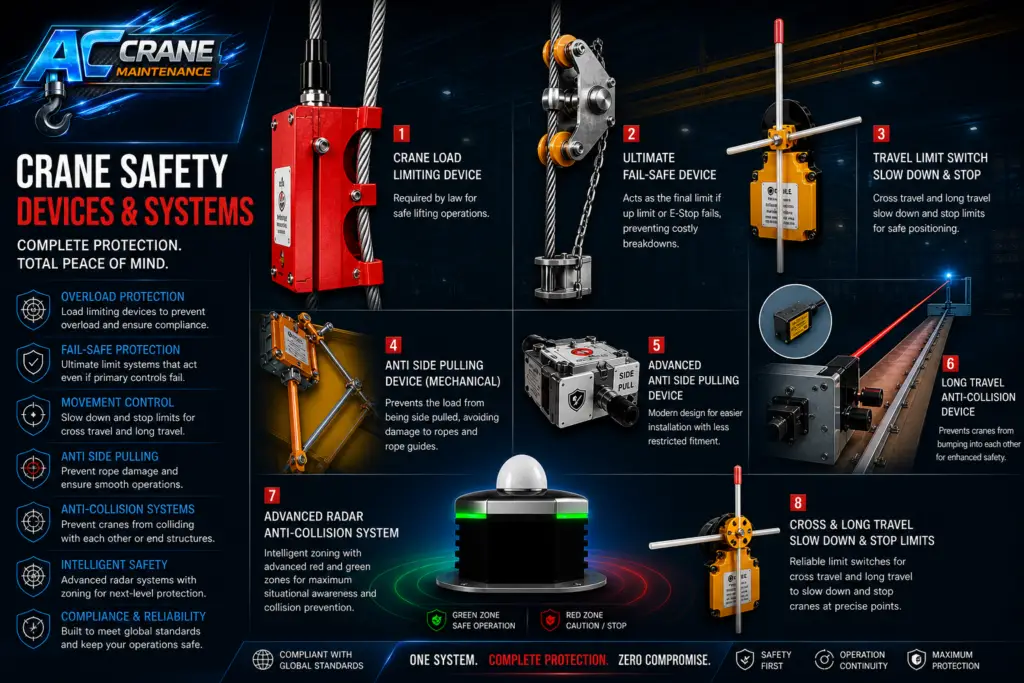
An overhead crane combines electrical controls, moving machinery, a suspended load and significant stored energy. Effective safety systems are therefore not one single device. Protection is normally built from several layers selected according to the crane design, capacity, duty, operating environment and site risk assessment.
Load monitoring and limiting systems help prevent lifting beyond the permitted capacity of the crane or hoist.
Operational and ultimate limits help prevent the hook block from travelling beyond the safe lifting range.
Anti-side-pull systems can detect or restrict lifting conditions where the rope or load moves outside the intended vertical lifting path.
Sensors and control logic can slow or stop cranes before defined crane-to-crane or crane-to-structure separation limits are exceeded.
Slowdown and stop limits can provide controlled deceleration near the end of long-travel and cross-travel paths.
Zoning systems can prevent or restrict crane movement into defined areas according to the engineered control strategy.
Monitor the lifted load and help prevent operation beyond the permitted lifting capacity.
A load-limiting system monitors load and is configured to prevent continued lifting when the permitted load threshold is exceeded. The exact sensing method and control arrangement depend on the crane and hoist design.
Depending on the system, load information can also be displayed to the operator through a digital load display or integrated into a crane control system.
The Driven Machinery Regulations include requirements concerning load indication and load limiting on power-driven lifting machinery. The exact regulatory application depends on the machine, capacity and applicable manufacture or refurbishment provisions.
Protection against dangerous hook-block or hoist overtravel.
A normal hoist limit controls the permitted operating travel of the hook. An independently arranged ultimate or final limit can provide an additional protective layer if the normal limiting system does not stop the motion as intended.
The exact limit arrangement depends on the hoist design. Limit systems may be rotary, mechanical, electronic or integrated into the control system.
An ultimate limit is intended as protective backup and should not be treated as the normal method of stopping the hoist during every lifting cycle.
Help prevent damaging lateral forces caused by lifting a load away from the intended vertical hoist line.
A conventional overhead crane hoist is intended to lift the load with the hook positioned appropriately over the load. Pulling a load sideways introduces lateral forces into equipment that is primarily designed for vertical lifting.
Depending on the crane and the severity of the condition, side pulling can affect rope tracking, rope guides, drums, hook blocks and other mechanical components.
Depending on the application, sensing systems can be used to identify unacceptable rope or hook angles and interface with the crane controls to warn, restrict or stop lifting motion.
Maintain engineered separation between cranes or between a crane and defined obstacles.
When two or more cranes operate on the same runway, or where a crane approaches fixed equipment or structures, an anti-collision system can provide an automatic layer of protection in addition to operator control.
The sensing technology and required stopping distances should be selected according to crane speed, control system, environment, layout and risk assessment.
Stopping distance is affected by crane speed, drive configuration, braking performance and load behaviour. Anti-collision settings therefore need to be engineered and commissioned for the actual crane installation.
Advanced position and distance-based control for complex multi-crane and restricted-area applications.
More advanced crane-control applications can use distance or position sensing together with programmed control logic to create different operating zones.
Depending on the selected technology and system design, the control can use measured position or distance to initiate warnings, reduce speed or inhibit selected movements before a crane reaches a defined restricted area.
Not every radar, laser, position or proximity system provides the same functionality. Available functions depend on the sensors, PLC or control architecture, crane drives and the required safety strategy.
Controlled slowdown and stopping before the bridge or trolley reaches the end of its permitted travel.
Where the crane control system supports it, travel limits can be arranged in stages so the crane or trolley first reduces speed and then stops at the final permitted travel position.
This is particularly useful on variable-speed crane systems because controlled deceleration can reduce the severity of end-of-travel impacts and improve positioning.
Crane safety cannot be reduced to a single device or a generic checklist. The required equipment depends on the type of lifting machine, its capacity, design, age, refurbishment status and applicable technical standard.
AC Crane Maintenance can assess an existing crane and recommend appropriate upgrades based on the actual machine and application.
Installing a sensor is only part of the job. The device must be correctly selected, positioned, wired, configured and integrated with the crane's control philosophy so that the resulting action is predictable and appropriate.
Inspect the crane, operating environment and existing controls.
Determine the movement, overload, collision or operational risk being controlled.
Choose suitable sensing and control equipment for the application.
Interface the system correctly with the crane controls and drives.
Set, function-test and verify the intended protective operation.
A modern overhead crane may use several protective functions together. The exact combination should be based on the crane and operating risk rather than fitting unnecessary devices simply because they are available.
Load limiting, upper and lower operating limits, final protection, brake monitoring where applicable and correctly configured controls.
Long-travel and cross-travel slowdown/stop limits, end-of-travel protection and suitable braking or VSD control.
Anti-collision sensing, controlled separation, slowdown zones and stop functions engineered around crane speed and stopping distance.
Position or distance-based zoning can help keep selected crane movements outside defined operating areas.
Emergency stops, correctly designed controls, warning systems and protective logic can reduce reliance on operator reaction alone.
Correct limit settings and load controls can help reduce damaging forces on ropes, gearboxes, brakes, wheels and structures.
An older crane does not always need to be replaced to improve its control and protection. Depending on its condition and design, existing cranes can often be modernised with updated electrical controls and suitable safety devices.
The correct safety strategy varies according to the crane, production process, traffic around the crane and operating environment.
Often, yes. The crane and its electrical/control system first need to be assessed to determine compatibility, the required protective function and the correct method of integration.
A load indicator provides information about the lifted load. A load-limiting function acts on the control system when the configured load threshold is exceeded. Some systems combine both functions.
Not necessarily. A normal operating limit defines the normal permitted travel. An ultimate or final protective arrangement can provide an additional layer of protection if the normal stopping function does not operate as intended.
Yes, where the selected sensors, crane controls and drive system support staged control. A typical engineered arrangement can use an approach or slowdown point followed by a final stop point.
Yes. Depending on the crane and required accuracy, suitable position, distance or zoning systems can be integrated with the controls to restrict selected movement into defined areas.
No. The correct protection depends on crane type, capacity, controls, speed, duty, operating environment, applicable technical standards and the risks presented by the specific installation.
Yes. AC Crane Maintenance can assess the application, supply suitable equipment, integrate it into the crane control system, configure the required functions and test the completed installation within the agreed project scope.
Whether you need one replacement safety device or a complete overhead crane control and protection upgrade, AC Crane Maintenance can assess the application and recommend a practical solution based on the actual crane, operating environment and required safety function.