Steel wire rope solutions for overhead cranes, electric wire rope hoists, mobile cranes and industrial lifting applications. We assist with rope selection based on the equipment, rope construction, diameter, core, lay direction, breaking load, reeving, drum and sheave arrangement, operating environment and duty requirements.
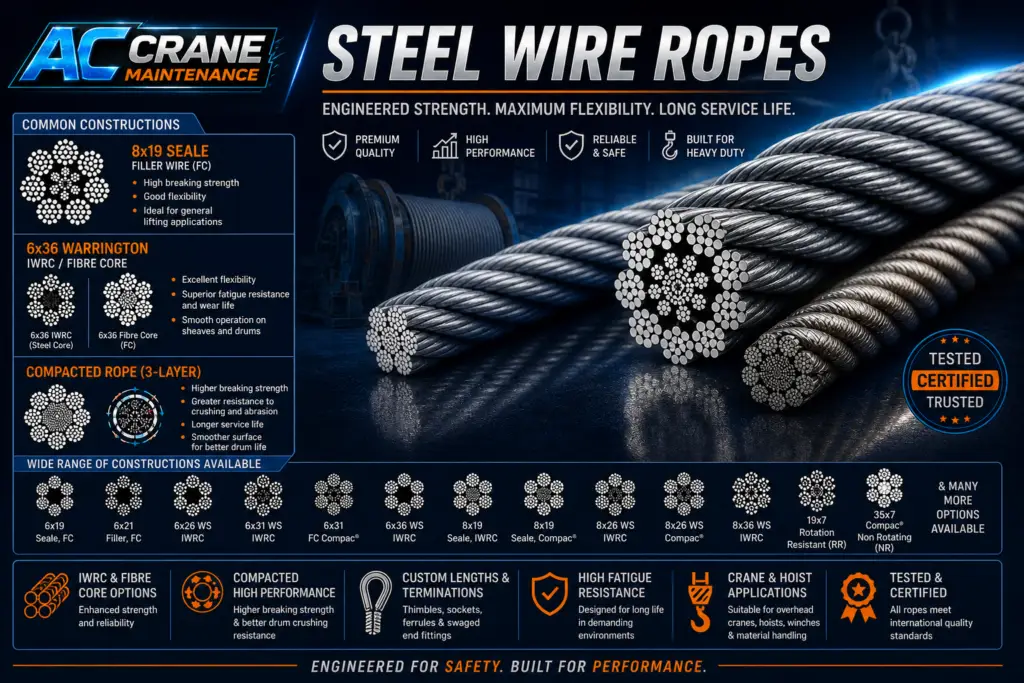
Two ropes with the same outside diameter can have very different constructions, breaking loads, flexibility, rotation characteristics, fatigue performance and resistance to crushing.
That is why replacing a crane or hoist rope simply because another rope has the same diameter can be a costly mistake. The replacement must suit the lifting machine, drum, sheaves, reeving arrangement, lifting height, duty and operating environment.
AC Crane Maintenance assists clients with standard crane ropes, IWRC and fibre-core constructions, compacted ropes, rotation-resistant ropes and specialist high-performance ropes for demanding crane and hoist applications.
Where possible, we identify the existing rope and machine specification before recommending a replacement.
Rope construction must be matched to the machine and application. The examples below represent common categories used across crane, hoist and industrial lifting systems; final selection should be confirmed against the equipment and rope requirements.
A commonly encountered wire rope family offering a balance between strength and abrasion resistance. Suitability depends on the specific construction, core, machine and application.
A more flexible rope family commonly considered where repeated bending over drums and sheaves is an important operating factor. Exact construction and specification must still match the machine.
Independent Wire Rope Core constructions provide a steel core and are commonly used where strength, structural support and resistance to crushing are important considerations.
Fibre-core ropes can offer increased flexibility in suitable applications. They should not be substituted for an IWRC rope without confirming the required machine and rope specification.
Compacted rope constructions can provide improved strand contact, increased metallic area and favourable performance characteristics for demanding applications when correctly selected.
Rotation-resistant and low-rotation rope constructions are used where controlling rope and load rotation is important. Selection depends strongly on the crane, reeving arrangement and application.
A correct rope specification considers the complete operating system. Changing one characteristic without considering the others can affect spooling, fatigue life, drum behaviour and overall performance.
We assist with steel wire rope enquiries across a broad range of lifting machinery and industrial applications.
Replacement rope for single and double girder overhead cranes, including rope hoists and open-drum lifting arrangements.
Rope selection and replacement support for industrial wire rope hoists used in manufacturing, engineering, mining and maintenance.
High-performance and specialist rope enquiries for mobile crane applications where the correct machine and existing rope specification can be established.
Steel wire ropes for industrial gantry and portal lifting systems, selected according to the lifting arrangement and machine design.
Wire rope for suitable industrial winches and pulling or lifting systems, selected around the actual winch design and application.
Specialist compacted, rotation-resistant and high-performance rope solutions for demanding crane applications where standard rope may not provide the required performance.
The required safety factor depends on whether the rope forms part of a lifting machine or is being used as lifting tackle. These should not be treated as the same application.
Wire rope deterioration can develop through normal service, incorrect spooling, unsuitable sheave or drum conditions, corrosion, mechanical damage or incorrect rope selection. Rope condition should therefore be considered together with the equipment it runs on.
AC Crane Maintenance is an overhead crane company, not simply a wire rope reseller. This allows a rope problem to be considered as part of the complete lifting system.
Where required and within the project scope, rope replacement can be combined with inspection of related crane and hoist components such as drums, sheaves, rope guides, limits, hooks and lifting mechanisms.
If a crane is repeatedly damaging ropes, replacing the rope alone may only reset the problem.
Send us details of the crane, hoist, existing rope and the type of damage being experienced. We can assess whether the enquiry should include the rope guide, drum, sheaves, reeving or other hoist components.
The more information we receive, the quicker we can identify the correct rope or investigate a suitable replacement.
That's fine. Send Nanike and our sales team clear photographs of the rope, crane or hoist nameplate, rope drum and any existing certificate or rope markings.
We can use the available information to investigate the existing specification and determine what additional information may be required before quoting.
Steel wire rope is one component of the lifting system. Explore related AC Crane Maintenance products and services.
Whether you need a standard crane rope, IWRC construction, compacted rope, rotation-resistant rope or a specialist high-performance solution, send us the equipment and rope information and we will investigate the correct option for your application.